hi
Metaphysical decorating is about creating and absorbing the Energy in our environments. By touching and relating to the objects we love, we give and take Energy to and from them. The Energy from these objects also connects us with every person in the objects’ pasts. That includes the designers, manufacturers, suppliers, transporters, warehousers, accountants, lawyers, cleaners, and every person who sells, resells, and formerly owned them. So, in connecting with our objects, we reach many others. This lesson is about our relationship with our objects and the world. Our things connect us to other individuals, cultures and even to the spirit of the earth.
Lessons in Connecting
When I was in my 20s, I bought a lovely string of fake pearls in a neighboring Woolworths. They formed a twelve-foot loop that reached almost to the ground. I could wear them doubled, tripled, knotted, or any variety of styles. Still, I wished for real pearls! Twenty-five years later, when I visited China, the opportunity arose.
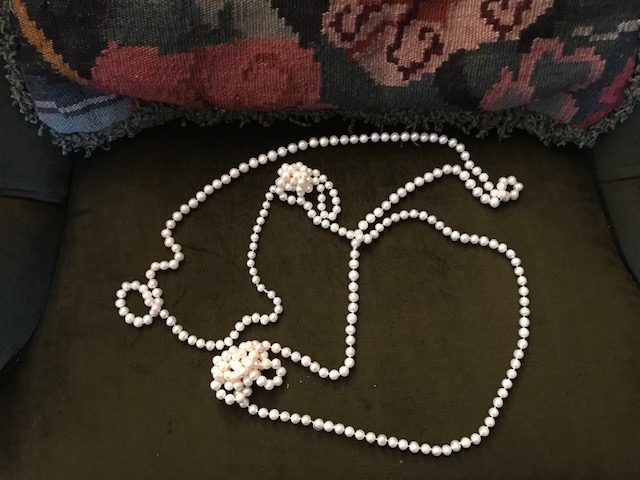
When the tour leader took us to a pearl center, we all went gaga. I bought six smaller necklaces and asked if the pearls could be restrung into one long necklace with protective double knots between each pearl. The salesman told me to come back early the next day.
That morning, I found a young woman finishing the last knots on my necklace. She looked at me with dagger, sleep-weary eyes. I knew in an instant she had been up all night stringing my pearls.
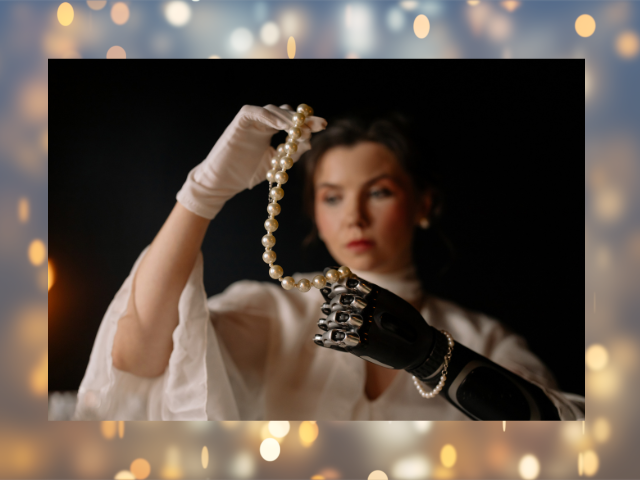
When I touched the necklace, I felt the negative Energy. The Lakotas and other Native-Americans believe things made with love have lots of “skan.” They believe that this brings healing Energy into our lives.[1] The pearls had just the opposite, no skan and much negative Energy
Our Connections Affect Our Lives
Nonetheless, I put the pearls to use, wearing them to weddings and fancy parties. Once, after two glasses of champagne and a few spins on the dance floor, I simply wanted to rip them off my neck. “They are just too heavy,” I complained to my husband. “Here, you wear them,” I said and threw them around his [whose?] neck, decorating his tuxedo. It became a running joke among our friends. I put them in a drawer not to be worn again.
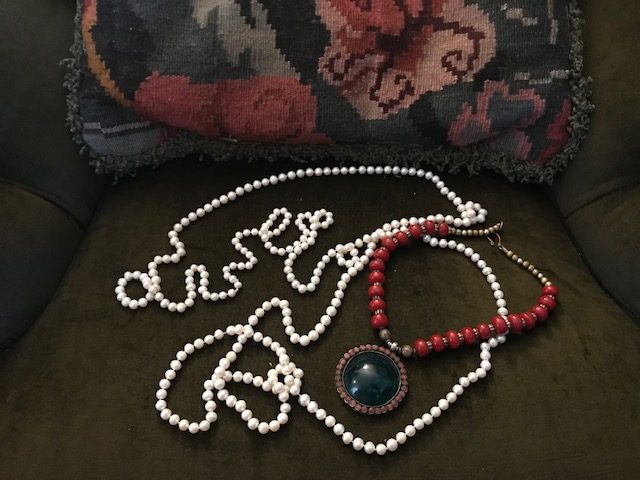
I have quite a different relationship with another piece of jewelry which I bought at the Museum of the Congo in Brussels. Luckily it was not from the Congo where human rights abuses prevailed in the late 19th and early 20th century. The moment I touched it, I felt love. Each time I wear it, I think about the artist. I always wondered if it was made for a loved one. When I touch it, I send gratitude back to the artist. I hope no one lost out by giving up this beautiful object.
How to Improve the Energy in Our Objects
At some point, a childhood friend brought up the pearls, reminding me how often I wore them in my twenties. I started thinking about them. I usually interact with my objects. The fake pearls from Woolworths were no longer around, but the Chinese pearls lay abandoned in a drawer.
Finding them in my jewelry box, I held them, and realized they still carried the negative Energy of the young woman who tied nearly 600 double knots. I brought into my mind the young woman with the tired eyes, and I told her I was grateful for her work. I told her I would never have asked for the alteration had I known she would be forced into this tedious work. As I vowed to be more sensitive to others, the pearls in my hands began to feel lighter. I started relating to the pearls like I did to the African jewelry.
Objects Connect Us to Everyone in the Universe
The life force, that “Energy without a word in the West,” runs through all matter, including our bodies. Its flow connects us to objects and the people who make them. We are connected through our things to everyone in the world.
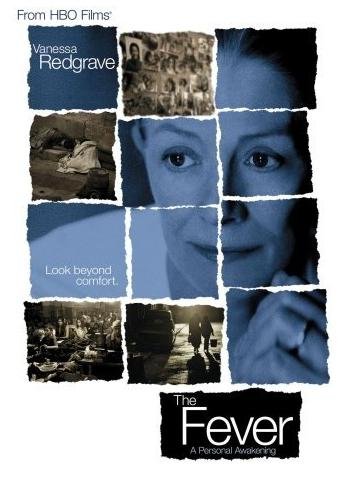

The connection between people and objects is beautifully shown in the film The Fever. Vanessa Redgrave plays a wealthy middle-aged woman traveling as a tourist to a third-world Eastern Europe country. In a countryside ravaged by war and poverty, she experiences an awakening. She comes down with fever that becomes a metaphor for the churn raging inside of her. One day, she finds a brown paper bag on her doorstep. Inside is an anonymous gift, a copy of Karl Marx’s Das Capital.
As she nurses her fever, she reads Marx’s expression of rage as he describes the coal workers, the child laborers, and other suffering workers. As she stumbles onto his “The Fetishism of Commodities” chapter, she realizes that to truly understand it, her whole life would have to change.
The Fever as Metaphor
In a feverish dream state, Redgrave’s character sees Marx’s ideas incorporated in the image of a coat:
“… As if that coat, suddenly appearing on the earth, contained somewhere inside itself an amount of value, like an inner soul, as if the coat were a fetish, an object with a living spirit. What determines the value of a coat? The coat’s price comes from its history, the history of all the people involved in making it and selling it and all the particular relationships they had. …”
If we buy the coat, we, too, form relationships with those people. Yet, we hide those relationships from our awareness. We pretend we live in a world where coats have no history, as if they fall from heaven with price tags attached.
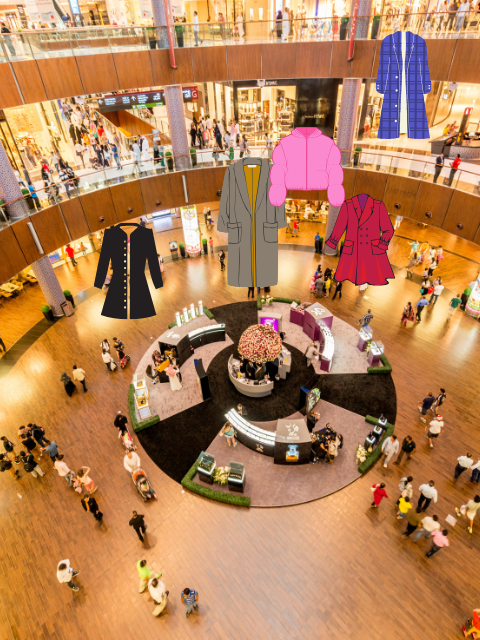
“I like this coat,” we say, “it’s not expensive.” It’s as if the cost were an important fact about the coat and not the facts about all the people who brought it to us. [2] [3]
So the fever takes the woman to a place that no one wants to be. It is a place where every object is examined for its effects on the world. The film’s tag line is Enlightenment Can Be Brutal, which is why it is so much easier to give up the material to get to the spiritual. Our relationship with objects can be hard; though beyond difficult, it is necessary. Such a step should be taken slowly. Redgrave’s character couldn’t take the burst of enlightenment all at once. At some point, her fever of awareness broke and she went back to her old life, her eyes shut to an awareness she could not handle.
Objects Have a History with The Planet
There are some objects made from materials with a bad beginning and a bad end. No matter how much we hold them and talk to them, nothing can be done to bring them to Energy. Plastic is one example. I don’t deny that plastic has had lifesaving uses in medicine and unchallengeable protective functions in children’s car seats or bike helmets. Plastic seems so dense to me, though, that it cannot give or take any Energy. It feels like an earthly black hole.
I hate the look of plastic. I hate being near it. Maybe I am just more comfortable with wood and metal. Like me, wood and metal are mortal and in the same paradoxical wabi-sabi [4] fashion. We both age into the beauty of imperfection. Plastic, however, seems immortal.
Plastic will remain in a landfill for a thousand years. It remains intact or degrades into nanoparticles absorbed into animal tissue and into our food chain. Depending on our habits and where we live, we could be swallowing a credit card’s weight in plastic every week. [5 [6] When we decorate for Energy, we must look at an object’s past and future, not just its present. Metaphysical decorating tells us that an object’s entire history affects us.
How to Handle Our Relationships With Objects
At this point, we might be running screaming to the woods to live the simple life like Thoreau, limiting our outerwear to a sheet and sandals like Gandhi, and abandoning the trappings of a materialistic life. Yes, it may be easier to strip down to a spiritual life, but that is probably not the door we are called to enter. Most of us are meant to live in the world with its negative trappings. We must learn to find our spiritual way by negotiating with the objects around us. This is the metaphysical decorating challenge.
I want us to go there gently. We cannot look at every object in our lives and ask who got hurt in the making. We would just come down with the fever return where we started.
A problem with capitalism is that it draws a curtain between our material possessions and their past, including the people who made them. Metaphysical decorating urges us to establish a relationship with our things and their history. Our possessions are not dead things but viable objects made to bring joy into our lives.
Opening Up the Curtain
We can gently ask who brought us each object we hold. Did they earn what they deserve? Were their working conditions dignified? Did the manufacturer hurt the planet making the object? Perhaps we can research some products and send feedback to the corporations and send gratitude to the maker. We can apologize to the maker if they suffered in any way. That is what we want — of our products to be made with love and if not so, to infuse love and gratitude into them with our entire being. We can ask ourselves whether we should have paid more for the object. In metaphysical decorating, we are connected to every object and every person. If they are happier, so are we. This life force Energy runs through all of us, animate and inanimate.
***
[1] Lance Hosey, The Shape of Green, Aesthetics, Ecology and Design (Washington DC: Island Press, 2012), p. 101.
[2] The Fever by Wallace Stevens.
[3} The Fever, produced by HBO films, 2004.
[4] Wabi-sabi is a traditional Japanese philosophy centered on finding beauty in imperfection, impermanence and simplicity. . It encourages an appreciation for things that are flawed, incomplete, or weathered, embracing the natural cycle of growth and decay. Rooted in Zen Buddhism, the concept challenges the Western pursuit of unattainable perfection, instead valuing authenticity and the quiet beauty found in the transient nature of everything
[5] “You Could Be Swallowing a Credit Card’s Weight in Plastic Every Week” (CNN. Com June 11, 2019).
[6]People who drink bottled water double their plastic ingestion.
[7] Elizabeth Royte, Garbage Land, On the Secret Trail of Trash (New York: Little, Brown and Company, 2005). Chapter Nine: “Satin’s Resin.”
***
There are two parts to this website, The Lessons, which are more difficult in concept, and the blogs, which are lighter in nature. A blog that you might enjoy with the same theme as Lesson Four is:
Please note that my website allows you to leave comments at the end of the blogs but not at the end of each lesson. If you have a comment or question about a lesson, you may email me at ruta@rutas-rules.com